“A country family picking their own hops”
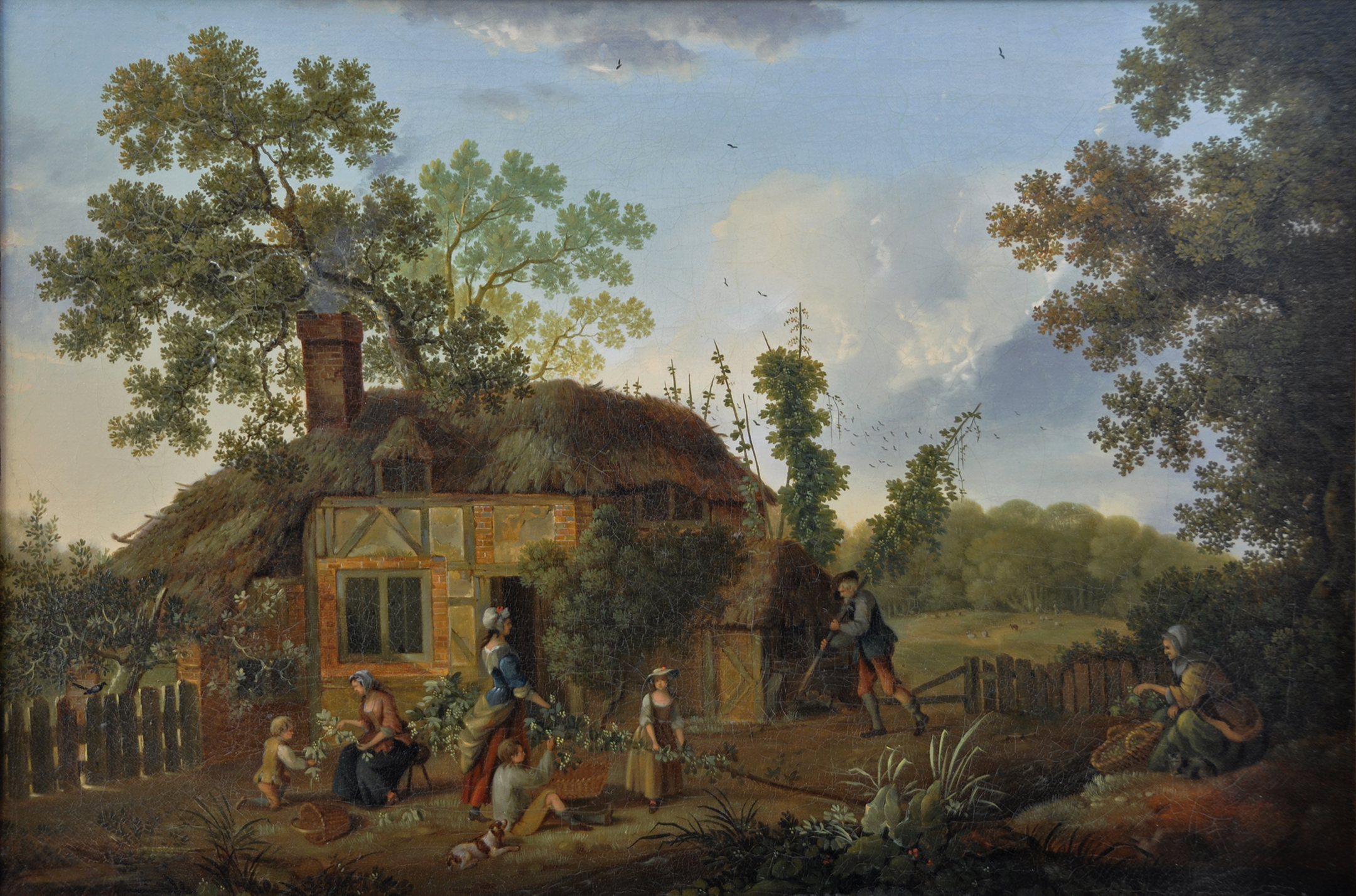
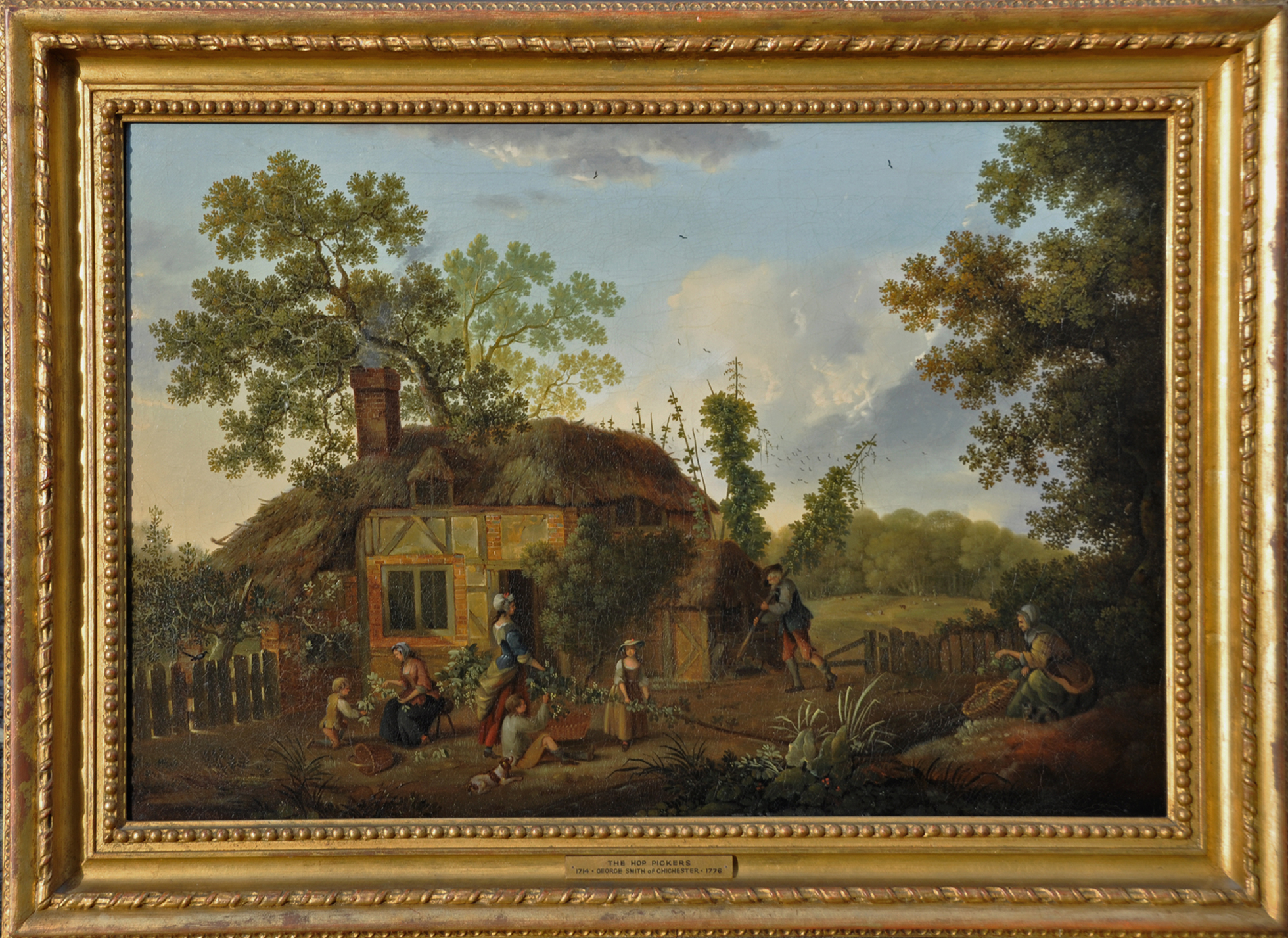
“A country family picking their own hops”
GEORGE SMITH of Chichester
1714-1776
English School
“A country family picking their own hops”
Oil on canvas, signed
42.6 x 62.6 cms
163/4 x 245/8 ins
Overall framed size 55.3 x 73.5 cms
213/4 x 29
Exhibited: London, Free Society of Artists, 1761, no. 23, as A country family picking their own hops
The Fine Art Society, London, 1964, no. 788.
Provenance: Collection of Baron Sir Henry de Bath (1823 - 1907)
His estate sale; Sotheby's, London, 13th May 1931
The Fine Art Society, London, 1964, no. 788,
Literature: A Catalogue of the Paintings, Sculptures, Models, Drawings, Engravings, &c. Now exhibiting in the Great Room belonging to the Society for the Encouragement of Arts, Manufactures, and Commerce in the Strand, London, 1761, p. 4, no. 23.
The Fitzwilliam Museum in Cambridge and the Nottingham City Museum each have a painting in their collection by William Pether (1713-1819) bearing the title: The three Smiths, Brothers and Painters, Natives of Chichester, aka George, John and William Smith of Chichester. All three brothers were talented artists who specialised mainly in landscapes and were popular with collectors in their lifetimes. M H Grant writes that George sold more landscapes in his lifetime than Richard Wilson and Thomas Gainsborough combined and that “Fashion placed him in the front rank…”
George is the best known and was the most skilful of the trio and his landscapes included Arcadian scenes rather in the manner of Claude Lorrain and pastoral and wooded scenes that reflect the influence of the leading 17th Dutch masters Meindert Hobbema, Jan Wijnants and Jacob Ruisdael. By the mid-eighteenth century, with a burgeoning middle class with an interest in collecting art, there was a shift in taste away from topographical scenes and an appreciation for more naturalism in art. The ensuing rediscovery of the Dutch masters coincided with George Smith and his brothers’ portrayal of well-executed and pleasing scenes of rural life.
George was the second eldest son of a family of five. There were three boys with the eldest brother William Jnr, born in 1707, who went on to work as a portrait painter as well as a landscapist, and his younger brother John who was born in 1717 and produced landscapes, sometimes in collaboration with George. There were also two sisters, Elizabeth and Sarah. Their parents, who had married at West Chiltington in 1705, were William Smith, who was a cooper involved in making barrels, buckets and wooden casks but later became a baker and Elizabeth, née Spencer, who was the daughter of a butcher from Horsham.
William Smith Jnr., although producing some landscapes and still-lifes, had set out to become a portrait painter and his work had impressed the 2nd Duke of Richmond who enabled him to study in London at the studio of a portrait painter in St. Martin’s Lane. George had been intended to continue his father’s trade as a cooper and was apprenticed to an uncle but did not find it to his liking and went to London to study with his older brother. George’s initial training was as a portrait painter but it was a discipline which did not suit him. Both he and William would return regularly to Chichester to paint the local environs and again the Duke of Richmond played a part in the Smith family’s fortunes because he employed George to paint landscapes for him to hang in his home, Goodwood House. Other notable patrons included the Duchess of Newcastle and Sir Matthew and Lady Fetherstonhaugh at Uppark.
The three brothers spent almost their entire lives in Chichester and garnered considerable patronage in Sussex and the adjoining counties. In about 1750, George and John shared a studio in North Street, Chichester. They also, later on in their lives, took to exhibiting their paintings in the London exhibitions where George showed four landscapes at the Royal Academy in 1774, two at the Society of Artists in 1760 and one hundred and three at the Free Society between 1761 and 1774 of which this painting was the first exhibit. He was also awarded the prestigious premium award for landscape painting at the S.A. in 1760, 1761 and 1763.
Grant also writes that: “None before him, and few since, have caught more perfectly than the subtle aroma of the depths of our English country. On his canvas we are conscious at once of that sensation of intense nationality combined with seclusion which so delightfully assails the Londoner who wakes in some farmhouse bedroom on his first morning in the country. There is a new smell in the air, a smell of wood smoke, of fresh leaves, of garden flowers, of thatch drying from the midnight dews. There is a new light, the light of clean air filtering through green. There are new sounds too, the gentle country sounds which make up silence, the murmur of quite industries of the cowman. The woodcutter and the tender of poultry….all of this George Smith both felt deeply and had the power to record perfectly, praise almost as high as is possible to accord an artist in a field where so many have striven, yet not too high for this quiet inhabitant of Chichester.”
Prints of George Smith’s work proved popular and were made by some of the best engravers of the time such as Francis Vivares, who engraved the Hop Pickers in 1760 and which was intended as a companion to an engraving after Gainsborough's Rural Lovers. It was to be plate 22 from an unidentified series and the British Museum holds a copy of the etching. Other engravers included Woollett, Elliot, Morris and Peake. George and John also collaborated on a volume of engraved etchings and prints. These featured some of their own works and also paintings of the popular Dutch Golden Age painters and took about fifteen years to compile. The collection, which totalled fifty-three prints, were assembled as an album and published by John Boydell in 1770.
Besides being a renowned landscape painter and still-life artist, the latter often produced in pairs depicting prosaic items such as plates of meat and cheese sometimes accompanied by a mug of beer, George Smith was also a musician, composer and poet. He performed at concerts in Chichester and charmed the audiences with his playing of the violencello. His Pastorals, a book of his poetry with a second edition published by his daughters in 1811, displayed his talent in that discipline and six copies of it were purchased by the Duke of Richmond. However, George is quoted as claiming that: “I never made the art of writing my particular study...my profession as a landscape painter induced me to study Nature very attentively”. He went on to say that his painting inspired ideas for the poetry “…many of which I flatter myself are new.” All of these attributes, combined apparently with a natural charm and outgoing personality, made him someone whose company was sought after.
John Smith was the first brother to die in July 1764, aged forty-seven, only a few months before William. George lived on until his death on 7th September 1776 when he was buried in in the cemetery on St Pancras Rd., Chichester. He lies in a tomb that he shares with his brothers, his wife Ruth and his mother.
Examples of the paintings and drawings by George Smith can be seen in: Tate Britain; Fitzwilliam Museum (5); British Museum; Windsor Castle; Government Art Collection; National Portrait Gallery (which has a landscape by George and John Smith depicting John painting and George declaiming poetry); Victoria and Albert Museum; The Council House, Chichester; Nottingham City Museum; Cheltenham Art Gallery; National Trust collections at Chastleton House, Antony and Angelsey Abbey; Yale Center for British Art and Art Institute of Chicago.
Some titles include: A musical thrasher playing on his pipe in a barn to his rustic family; A snow piece; A white frost; A moonlight; A landscape and figures with the sun going down; A snow piece with a house on fire; Winter scene with classical ruins; A view of Chichester; Stormy coastal scene with ship foundering; Man in green coat holding a hare with four hounds at his feet: Still-life of a joint of beef with numerous vessels and utensils on a white cloth; Still-life of cheese, beer and bread; A piece of fruit on a plate and A tulip.
Finally, another quote from M H Grant where he writes about this painting: “But a Hop Pickers may perhaps be singled out, a gem of grouping both floral and human, which so exactly embodies Horace Walpole’s little prose poem, that it is difficult to believe that the Sussex painter had not read the passage and set himself to illustrate it.”
Bibliography:
The Dictionary of British 18th Century Painters – Ellis Waterhouse
Old English Landscape Painters Vol.2 – M H Grant
British Landscape Painting of the 18th Century – Luke Hermann
A Dictionary of British Sporting Artists – Sydney H Paviere
How award-winning landscape artists The Smith Brothers of Chichester – Amy Roberts, Novium Museum, Chichester
Chichester Poets – Lorna Still, Novium Museum, Chichester
HOPS AND HOP PICKING IN ENGLAND
Hops are used in the production of beer and impart flavour, bitterness, citrus taste or aroma to the process and different varieties are used by brewers for the kinds of beer, whether it is an ale type or a lager, and for the kind of flavours that can be achieved within those types. It is the flower that is harvested and they are gathered in late summer or early autumn picked from the vigorous climbing perennial plant known in England as hop bines.
It is believed that the first wild hops came to Britain after the Roman conquest but it was not until 1524 that cultivated hops were first grown in Kent. Hops had been used on the continent since the 9th century and England had imported hops from the Netherlands, France and Germany since circa 1400 and they gradually supplanted the traditional use of a mixture known as gruit, which comprised a blend of burdock root, horehound, marigold, heather and dandelion, in the brewing process. Traditional English beer had always been spiced ale which was brewed from malt but it was a short-lived product and had to be consumed soon after brewing. However, adding hops to this mixture helped to extend its lifetime although the bitter taste that the hops imparted was not universally accepted at first. It was Flemish weavers, working here, who were probably responsible for bringing hop cultivation to England in the first quarter of the 15th century. Although there was planting in several areas of England and up into Scotland, it is mainly Kent and Sussex and parts of Essex and Suffolk and in the west Midlands in Herefordshire and Worcestershire where they were concentrated. In the south-east of England, hops are grown in hop gardens and in the west they are known as hop yards, which is the same as they are called in the US after the establishment of the crop in 1629, initiated by English and Dutch farmers who had emigrated there.
In the second half of the 17th century, the cultivation of hops expanded in Kent and it was not only larger farms that specialised in growing hops, often providing them for specific breweries, that were responsible for this but also small establishments who would utilise one small field. The climate in Kent and the fertile soil - not for nothing was it known as the Garden of England – provided ideal conditions for hop growing. In spring, the hop bines were grown up strings that were attached from the ground to a grid of lines held up by long chestnut poles and had to be constantly maintained to ensure that they carried on growing up the strings which entailed the farm workers twisting them round the string. The crop was harvested in September and then the stripped bines were cut back ready for the process to be repeated the following year.
The harvest was the busiest time of year and required a much larger workforce and local people and itinerant workers would get paid for each sack of hops that they filled. In the 19th century it became a popular working holiday for Londoners from the East End who came down on Hopping Special trains from London, often as entire family units. George Orwell was one who came to pick hops in 1931 and wrote about it in his diary.
The sacks of picked hops were then taken to be dried in specially designed oast houses which proliferate particularly in Kent and East Sussex. Squat round brick buildings with a high conical roof capped with a wooden cowl that could be turned to benefit from the wind direction, they are still landmarks to this day although most are now used for other agricultural purposes or have been turned into homes. The hops were laid on the floor and regularly turned to ensure even drying.
RELATED ITEMS