The East Indiaman Dutton in three positions off Dover
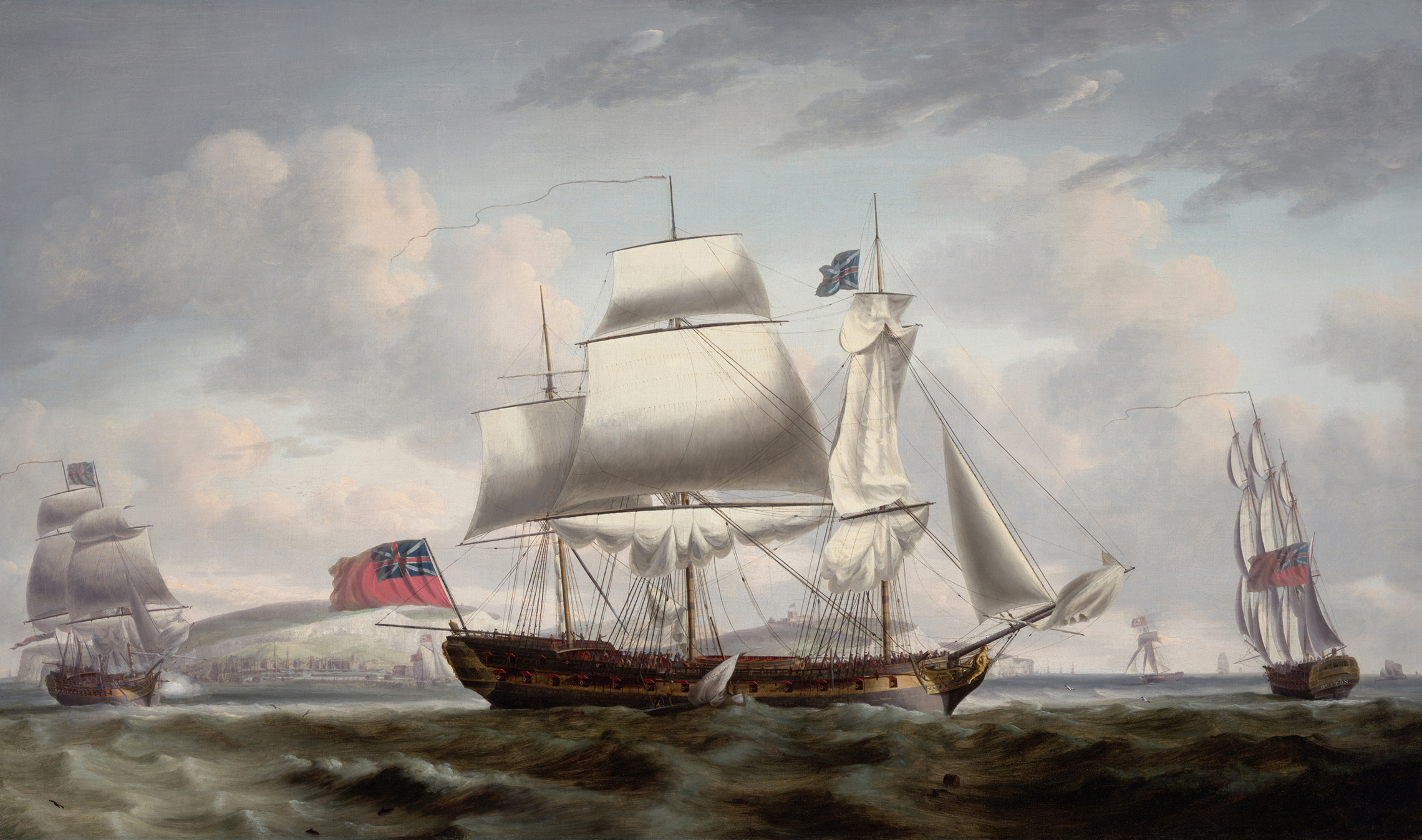
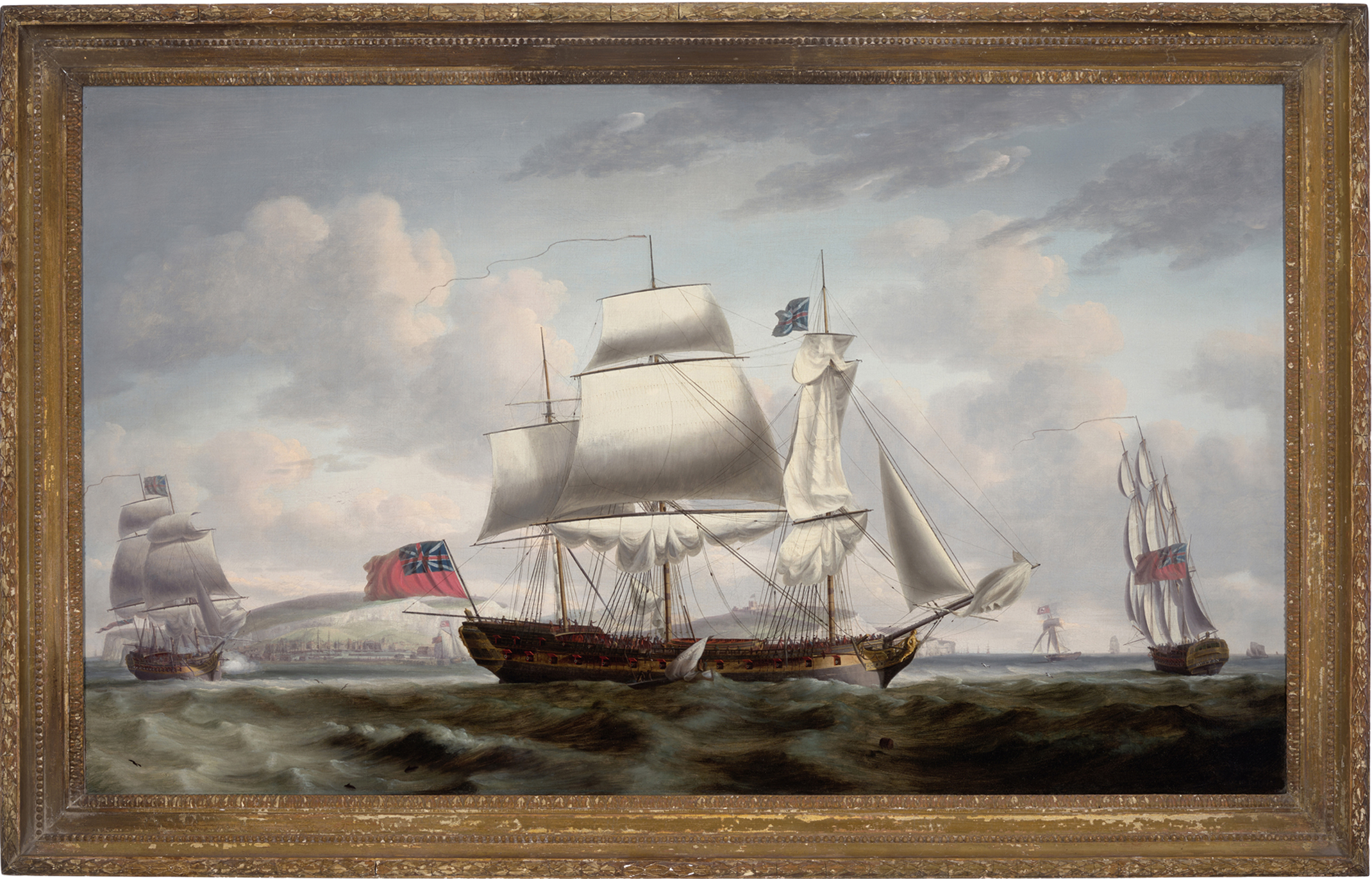
The East Indiaman Dutton in three positions off Dover
ROBERT DODD
1748-1815
English School
The East Indiaman Dutton in three positions off Dover
Oil on canvas, signed and dated 'Robt. Dodd 1786' (lower right)
88.3 x 149.9.cms
343/4 x 59 inches
Provenance: Commissioned by Capt. Henry Rice (1743 - 1797), Managing Owner of the Dutton, and thence by descent
With Martyn Gregory, London, 1988
Collection of Thomas James Perkins (1932–2016), Belvedere, California
Thence by descent to private collection, Tiburon, California
Exhibited: (Probably) London, Royal Academy of Arts, 1787, no. 390, as 'Homeward bound East Indiaman taking a pilot off Dover'.
London, Martyn Gregory, Chinnery and Paintings of the China Coast, 14 June - 8 July 1988, no. 41.
THE DUTTON
In Dodd's painting, the Dutton is shown in three positions off Dover. This almost certainly depicts her second voyage, spanning the years 1785 -6, when she set sail from Portsmouth on 17th April 1785 under the command of Captain West, bound for Bengal and Madras. She reached the latter on 7th September. On the return leg, St Helena was reached on 23rd May 1786 arriving at the Downs on 8th August.
Sailing out of the Channel ships had to negotiate the busy Narrows (the Straits of Dover), winds permitting. In the left background the ship, sailing up Channel, fires a gun and hoists the Union flag at the fore topgallant masthead to request a Pilot, who is seen setting off in a lugger to the right. In the centre, the ship is shown in profile, hove-to (with sails backed to take the way off the ship) and hauling down the Union as the Pilot comes on board from his lugger alongside. At the right the Indiaman stands away for the Downs and the hazards of the Forelands, Goodwin Sands and the Thames Estuary.
The Dutton was built for the owner Henry Rice by John Barnard at Barnard’s Thames Yard in Deptford and was launched on 13th July 1781. The ship was an East Indiaman and was originally named Director but this was changed to Dutton before construction was completed.
Her overall length was 142 feet 9 inches, the keel 115 feet 10 inches, the beam 35 feet 2 inches and the tons burthen 780. (Tons burthen, also known as Builder’s Old Measurement, BOM or OM was the method in use in England between around 1650 to 1849 to calculate the cargo capacity of a ship. From the length and beam of the vessel, the tonnage of a ship could be estimated. The term went through various iterations from the Middle English byrthen to
Early Modern English burthen and then to burden. King Edward I had levied the first tax based on tons burthen in 1303 and it was not until steam propulsion usurped that of sail, with the consequence of much of the below decks space being taken up with boilers, coal and machinery, that a new system had to be found and that appeared in 1849 with the Moorsom System.) There were three decks on the Dutton, she had a crew of 100 men and was armed with 26 guns, some 6-pounder and the rest 9-pounders.
The Dutton was the second ship of this name owned by the Rice family. The first Dutton was another EIC ship built in 1763 and was originally captained (but not owned) by Henry Rice's uncle Capt. David Rice (d. after 1769) and appears to have been captained by Henry from 1770. The ship was sold in 1775 and foundered in a gale in 1782 off Newfoundland.
The second Dutton made five voyages for the East India Company to India and China trading in tea, spices and silks and these were highly lucrative for Captain Henry Rice. However, on 25th July 1795, she and many other East Indiamen were conscripted by the Royal Navy as a troop transporter for Admiral Hugh Cloberry Christian’s military expedition to the West Indies under the command of Lieutenant-General Sir Ralph Abercromby. The fleet set sail from Plymouth on three departure dates: 6th October, 16th November and 9th December, however adverse weather conditions forced the ships to return to harbour. The Dutton, with sickness affecting most of those on board, was part of the group that arrived back in Plymouth on 25th January. The gale that built up on the following day caused the ship to drag her anchors and she was driven on to the shore near the Citadel flagstaff., her back broken.
Rescuing the crew in heavy seas was a formidable challenge and it was largely due to the heroics of Edward Pellew (1757-1833), the captain of HMS Indefatigable and commander of the Western Squadron, that most of the over 400 crew, troops and some women and children were saved. Pellew was a large man and, in his youth, had gained a reputation for pugnacity before running away to sea at 14 years old. He was a strong swimmer and had rescued crew members before who had gone overboard. Noting the perilous situation, he swam out to the wreck with a line and with assistance from Lieutenant Jeremiah Coghlan, was able to establish a lifeline of breeches buoys. Pellew’s bravery was rewarded with a baronetcy later that year and in later life he became a politician as well as Admiral of the Red and was elevated to the peerage as 1st Viscount Exmouth.
The wreck of the Dutton was a total loss and she was sold as salvage for £850 but the event itself, largely due to Pellew’s heroism, became seen as something to be celebrated and its renown drew several artists to depict the scene including Samuel Prout and Thomas Luny (now in the collection of the National Maritime Museum).
ROBERT DODD
E H H Archibald, the former Curator of Oil Paintings at the National Maritime Museum, writes in his Dictionary of Marine Painters of Britain and America: (Robert Dodd) “… one of the principal recorders of the naval aspects of the American War of Independence and the French Revolutionary Wars.”
Robert was one of three sons and his younger brother Ralph, (c.1756-1817) was an engineer and a marine painter, who painted in a similar style to Robert and also exhibited at the Free Society and Society of Artists. However, the younger brother became better known for engineering drawings which he exhibited from 1799 to 1817.
It is not known from whom or where the brothers received instruction in painting. Robert initially concentrated more on landscapes and consequently many of his marine works show attractive landscapes in the background. A good example of this is his large View of Woolwich, painted in 1784, which has a significant ratio of the painting portraying figures on the bank in the foreground and buildings curving round the harbour on one side with an attention to detail that can be discerned also in the works of William Anderson.
Having decided to concentrate on marine painting, he continued the tradition of the late 18th century with, for example, commissioned works portraying a ship in three positions. If the ship was a merchant vessel, then the harbour or the environs from where it operated would often be depicted in the background. The East India Company’s influence and wealth was at its zenith at this time having been granted exclusive trading rights in 1711 and was importing considerable amounts of tea, cotton, raw silk and calico. Artists such as Dodd and Francis Holman were among a group of highly proficient artists who benefited from commissions from ships’ owners or captains.
In 1779, Robert Dodd was living near St James’s Stairs, Shadwell at 33, Wapping Wall and appears to have shared the premises with his brother Ralph. This location was ideal for the study of ships and all the ancillary trades associated with them as it was one of London’s largest dockyards. He would also have had ample opportunity to meet captains, officers, crew and owners garnering not only deep knowledge of the artist’s chosen subject but also valuable introduction to possible commissions.
He exhibited his first paintings in a major London institution in 1780 when he showed three works: A group of shipping in a storm; Evening, with a light breeze and Engagement by moonlight at the Society of Artists followed by his first exhibits at the Royal Academy in 1782: Captain McBride in the Artois frigate capturing two Dutch Privateers on the Dogger-bank and A View of the Whale-fishery in Greenland. He continued to exhibit there until 1809.
His meticulous observation of ships and the way that they sat in the water, factors which he was able to physically translate onto canvas, was rewarded by an increasing number of influential patrons. He was painting diverse marine subjects including ship portraiture, naval dockyards including those at Blackwall, Chatham, Deptford, and Woolwich as well as the aforementioned Wapping, Thames views such as Shipping on the Thames with Limehouse Church and View of the River from Westminster Bridge during the late Conflagration of Drury Lane Theatre, spectacular sea pieces with ships caught in tempests and accurate painted records of the naval engagements of the French Revolutionary Wars and the American War of Independence.
In about 1783, Dodd started to engrave and make aquatints of his own works and during his life published over one hundred of them. These, as well as engravings produced of his work made by other print makers such as R Pollard, C Morrison and F Jukes, especially those of naval victories, were highly popular and further enhanced his reputation. His utilisation of strong light effects, the dark of smoke from a burning ship contrasting with flames or with a light sky, and rays of sun breaking through storm clouds, lent themselves well for dramatic black and white engravings. Dodd illustrated with engravings the highly popular poem The Shipwreck by William Falconer which was published by William Baynes in 1811.
Robert Dodd’s major work depicted the rescuing of the crew of the Vengeur du Peuple which was sinking after Lord Howe’s victory on 1st June 1794. He painted it in 1795 and it was commissioned to hang in the dining room of Half Way House, Commercial Road which was his local inn. Because of its large size, 76 x 134 inches, he had to paint it in situ and it is now in the National Maritime Museum in Greenwich.
Other examples of his work include: The Victory sailing from Spithead; Lord Hood, with the fleet under his command, taking possession of the French anchoring ground in Bassaterre-road, St Kitts, the rear division of the British engaging the French centre; Lord Nelson’s ship “Victory” leading the van into action, on the 21st September 1805,with the “Temeraire” and the “Neptune”, Captain Freemantle bearing up to engage the “Santissima Trinidada”; A view on the Thames at Billingsgate at low water; Greenwich from the Isle of Dogs; The victory of Lord Rodney over the French fleet off Domenica 12th April 1782; Landing of British troops, under General Sir Ralph Abercromby, on the island of Texel, Holland 27th August 1799; Portrait of an Indiaman, with a view of the Island of St Helena; The mutineers turning Lt Bligh and some of the officers and crew adrift from His Majesty's Ship Bounty; HMS Shannon taking USS Chesapeake 1st June 1813.
Dodd had married Mary Fulton on 1st November 1772 and they resided at several addresses in London. Towards the end of his life, he was living at Lucas Place, Commercial Road, having moved there from Charing Cross. His last home was in Redman’s Row, Mile End, Old Town where he died in 1815 and was buried at St Dunstan and All Saints, Stepney on 20th February.
Works by Robert Dodd can be seen in the collections of the following museums and institutions: National Maritime Museum (22 works); Fitzwilliam Museum; Science Museum; National Army Museum; Merseyside Maritime Museum; Government Art Collection; Royal
Navy Museums, Portsmouth; Guildhall Art Gallery; Britannia Royal Navy College; HMS Excellent, Portsmouth; National Trust (Hinton Ampner); US Naval Academy, Annapolis
Bibliography:
The Dictionary of Sea Painters of Europe and America – E H H Archibald
Marine Painting in England 1700 – 1900 – David Cordingly
The Old English Landscape Painters Vol. 4 – M H Grant
Dictionary of British Marine Painters – Arnold Wilson
Dictionary of National Biography
British Museum online
RELATED ITEMS