
The Summer Eights, New College Boat Club, Oxford University with their barge bearing supporters and a view to Christ Church Meadows beyond
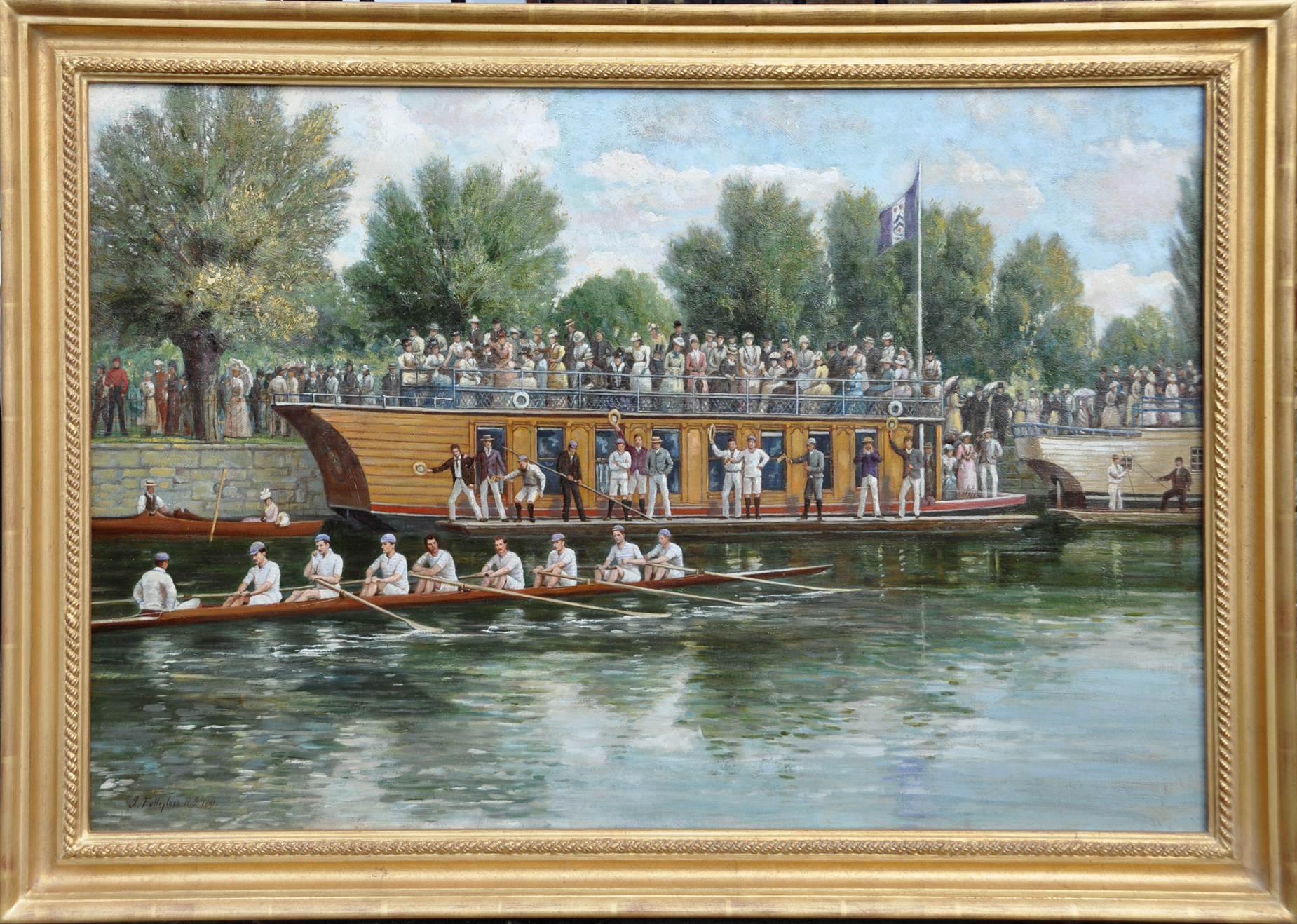
The Summer Eights, New College Boat Club, Oxford University with their barge bearing supporters and a view to Christ Church Meadows beyond
JOHN FULLEYLOVE R.I., R.O.I
1845-1908
English School
The Summer Eights, New College Boat Club, Oxford University with their barge bearing supporters and a view to Christ Church Meadows beyond
Oil on canvas, signed and dated 1891
60.7 x 91 cms
237/8 x 35¾ ins
Overall framed size 72.5 x 10³ cms
28½ x 40½ ins
We are most grateful to the President and Archivist of New College Boat Club who have provided the following information about the painting.
“I would say that it is certainly New College barge; compare the enclosed photo of it from 1887, with an eight in front of it, wearing probably the same kit of thinly hooped zephyrs, and caps. The flag in the photo is not very clear but it could be the same as the flag in the painting. The painting certainly looks like Eights, in which case the crew in 1891 was Hornby CH, Haworth JG, Hodgson WFS, White Cecil A, Drake FC, Ampthill, Lord Oliver, Coventry RW, Morgan HT, Colomb RP. The date looks correct as well as the second enclosed photo shows the barge in 1909, by which time we had clearly moved on to a new one. The people on the barge and the pontoon look fairly excited so I would suggest that, judging by the crowds, it depicts perhaps the end of racing on 20 May when, as you say, New College finished 2nd on the river, having chased the head crew, Brasenose, fruitlessly every day; in fact all the top 7 crews rowed over all 6 days.”
The successor to the 19th century New College barge is now housed at Twickenham. Each College had a barge for storage of boats, blades etc and also for use as entertainment. They were often old livery barges from the London Guilds.
John Fulleylove depicted landscapes, genre scenes, architectural and topographical subjects and portraits. His primary medium for these works was watercolour although he did use oil paint as well and he travelled widely to source his subject matter representing scenes in Greece, Palestine, France, Belgium and Italy as well as in the UK.
He was born in a house in Yeoman Street, Leicester on 18th August 1845, the youngest of five children and his father John was a coach builder. Educated at Mill Hill School which evolved into Leicester Grammar School, aged sixteen, Fulleylove initially started training to become an architect at the practice of Flint and Shenton in the city. However, his spare time was taken up with sketching in the natural landscape and studying and drawing architecture, particularly of his native town and its environs. He received some artistic instruction from the drawing master Henry Ward and continued to study and draw the city of Leicester and its environs before travelling further afield, influenced by his friend the landscapist Thomas Collier. Eventually the lure of being an artist proved stronger than that of being an architect and he left the practice and resolved to follow his passion.
In 1871 John Fulleylove sent his first exhibits to The Royal Society of British Artists in London from his address at 25 Castle View, Leicester. They were both views of York, the first, no.215 in the inventory that year was The Shambles, York which was priced at £8 and the second was titled At York, no. 217 and for sale at £6 10/-. His first exhibited work at the Royal Academy was in 1873 with a painting bearing the title The Belfry, Bruges. These represented the start of a long association with the exhibiting venues in London and elsewhere over his career including ten works at the Royal Academy, fifty-five at the Royal Institute of Painters in Oil Colours, 133 at the Royal Institute of Painters in Water Colours, ten at the Royal Society of Artists, Birmingham, 407 at the Fine Art Society in London, sixteen at the Royal Society of British Artists, six at the Royal Hibernian Academy, eleven at the Manchester City Art Gallery and eighteen at the Walker Art Gallery in Liverpool.
Some titles of exhibited works during his career include: Magdalen College, Oxford, from the Cloisters; Queen’s College, Oxford; The Library, Oriel College, Oxford; Rivaulx Abbey, Yorkshire; Hampton Court; Pulteney Bridge, Bath; Fitzwilliam Museum, Cambridge; The Village Sawpit; The Lantern, Rouen Cathedral; Place de la Concorde, looking towards Madeleine; Ruins of the Roman theatre at Arles, columns of Proscenium; The Temple of Jupiter and the Acropolis, Athens; Interior of the Mosque of Omar, Jerusalem; and Shrine of the Holy Sepulchre, Jerusalem
1875 marked the year of his first overseas painting expedition and this was to Italy and some exhibits in 1877 reflect this with Study of a baker’s oven – Pompeii; Tomb of Virgil and Grotto of Posilpo, Naples; and Courtyard of a House, Sorrento.
In 1878, he married the daughter of a wool merchant, Elizabeth Sara Elgood. She was also an artist as were her brothers, Thomas and George Samuel, and the latter had studied for a while under Fulleylove. The brothers and brother-in-law would often sketch the Leicestershire countryside together. George (1851-1943) became a well-regarded painter and garden illustrator and was elected a full member of the Royal Institute of Painters in Watercolours.
The newly wedded couple remained in Leicester at 24 Regent’s St, which was his parents’ house, but they were able to get away for summer sketching and drawing trips to Cheshire, London and France. However, in 1883 the Fulleyloves moved to 32 Mecklenburgh Square, a large house in Bloomsbury, London where they became part of an artistic circle that had several well-known artists in its ranks such as James Orrock and Sir James Linton. Ten years later they moved to Great Russel St. before eventually moving to Church Row in Hampstead where they remained for the rest of his life.
The Fine Art Society in London staged eight one-man shows of Fulleylove’s work between 1886 and 1906 and it was these that probably enhanced his reputation more than any other representations at exhibitions. The 1896 show in particular proved to be a great success and it was comprised of ninety drawings made on his Greek journey in the company of his fellow artists and friends Alfred Higgins and Somers Clarke. This exposure paved the way for more work as an illustrator of landscapes and for book illustrations with the publishers A & C Black being keen commissioners for their publications.
He had already illustrated several books and the first of these, published in 1889, was Oxford by Edward Thomas. Other publications included Pictures and Sketches of Greek Landscape; The Stones of Paris; Henry Irving; In the Footsteps of Charles Lamb; Middlesex; Edinburgh; John Kelman’s The Holy Land which was published in 1905 and Arthur Poyser’s The Tower of London in 1908. He also contributed to The English Illustrated Magazine; The Illustrated London News; The Picturesque Mediterranean; Good Words and Pastorals of France. Volume 7 of The Studio 1896 features an article Mr Fulleylove’s Drawings of Greek Architecture and Landscape.
Fulleylove’s stature as an artist was recognized by his peers and he was elected Associate Member of the Royal Institute of Painters in Water Colours in 1878 with full membership coming in the following year. In 1883 he was elected a full member of the Royal Institute of Oil Painters and became its Vice-President in 1906. He received a bronze medal at the Exposition Universelle in Paris in 1889 and an honourable mention at the Exposition Universelle in 1900. He served as President of the Oxford Art Society between 1907 and 1908.
John Fulleylove died suddenly in Hampstead on 22nd May 1908 while illustrating another work for A&C Black on the subject of Eton. He was survived by his wife, a son and two daughters. One of the daughters, Joan, became a renowned stained-glass designer and one of her commissions was for the Anglican cathedral in Khartoum and John Christopher, the son, became an illustrator, architect and draughtsman.
Fulleylove was buried in Highgate Cemetery but the National Portrait Gallery has in its collection an albumen cabinet card by Elliot and Fry showing his likeness. His work is
represented in the collections of the following museums and institutions: Tate Britain, British Museum; Victoria and Albert Museum (15); Ashmolean Museum (4); Walker Art Gallery, Liverpool; Fitzwilliam Museum; Nottingham City Museums and Galleries; Russel-Cotes Museum; Leicester Museum and Art Gallery (6); Leicester Town Hall; Leicester County Council Museum Services; Samuel Johnson Birthplace Museum; Preston Park Museum; Darlington Library; Touchstones, Rochdale; All Souls’ College, Oxford University; Victoria Art Gallery; National Museum, Cardiff.
Bibliography:
Dictionary of British Artists working 1900-1950 – Grant M Waters
The Dictionary of British Book Illustrators and Caricaturists 1800-1914 – Simon Houfe
The Dictionary of Victorian Painters – Christopher Wood
British Museum website
RELATED ITEMS


