
Dogs and a cat at the base of a tree with a red squirrel, squirrel monkey, parrots, macaw, parakeet, kingfisher, bull finch, starling and collared dove in the branches above
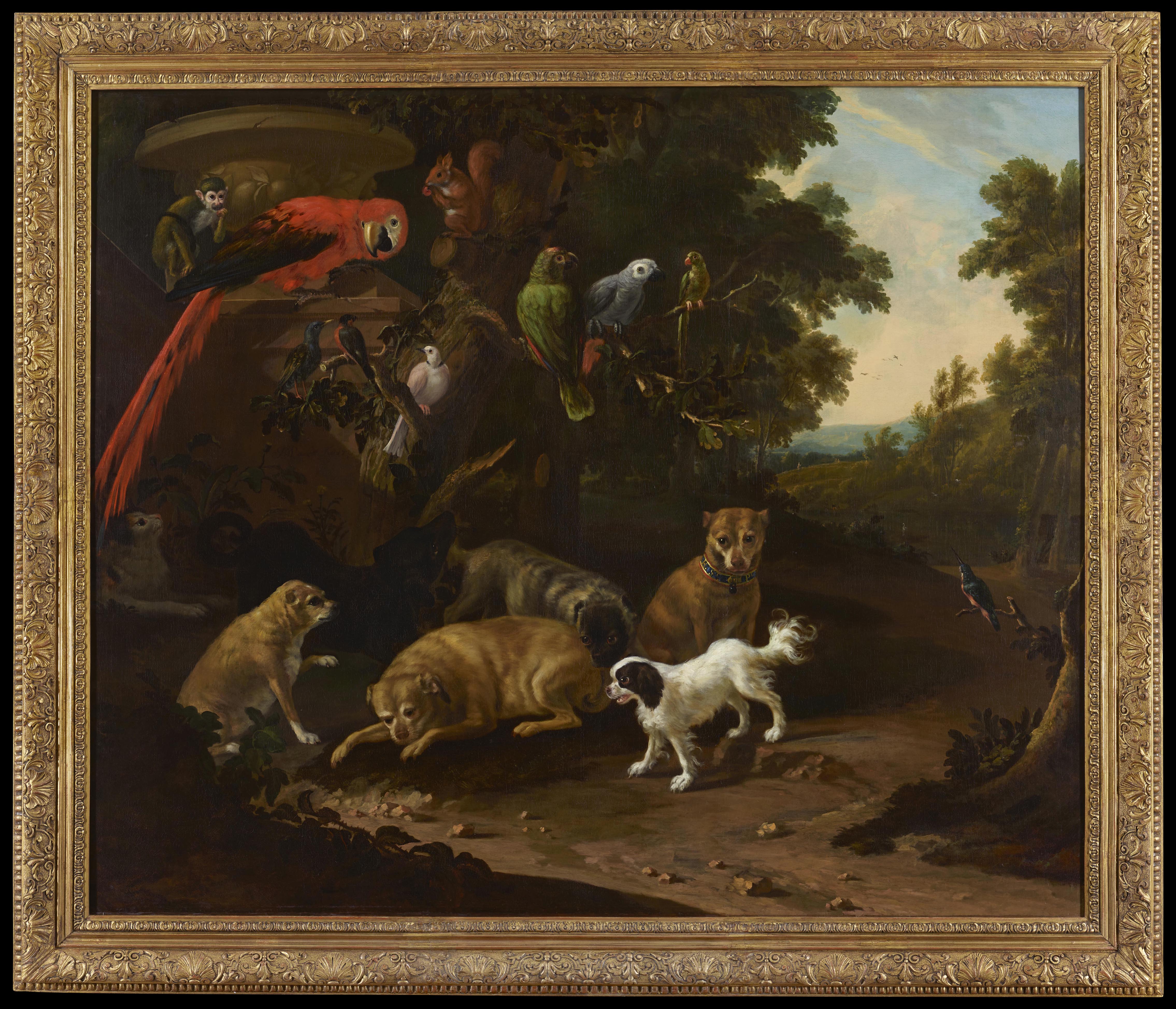
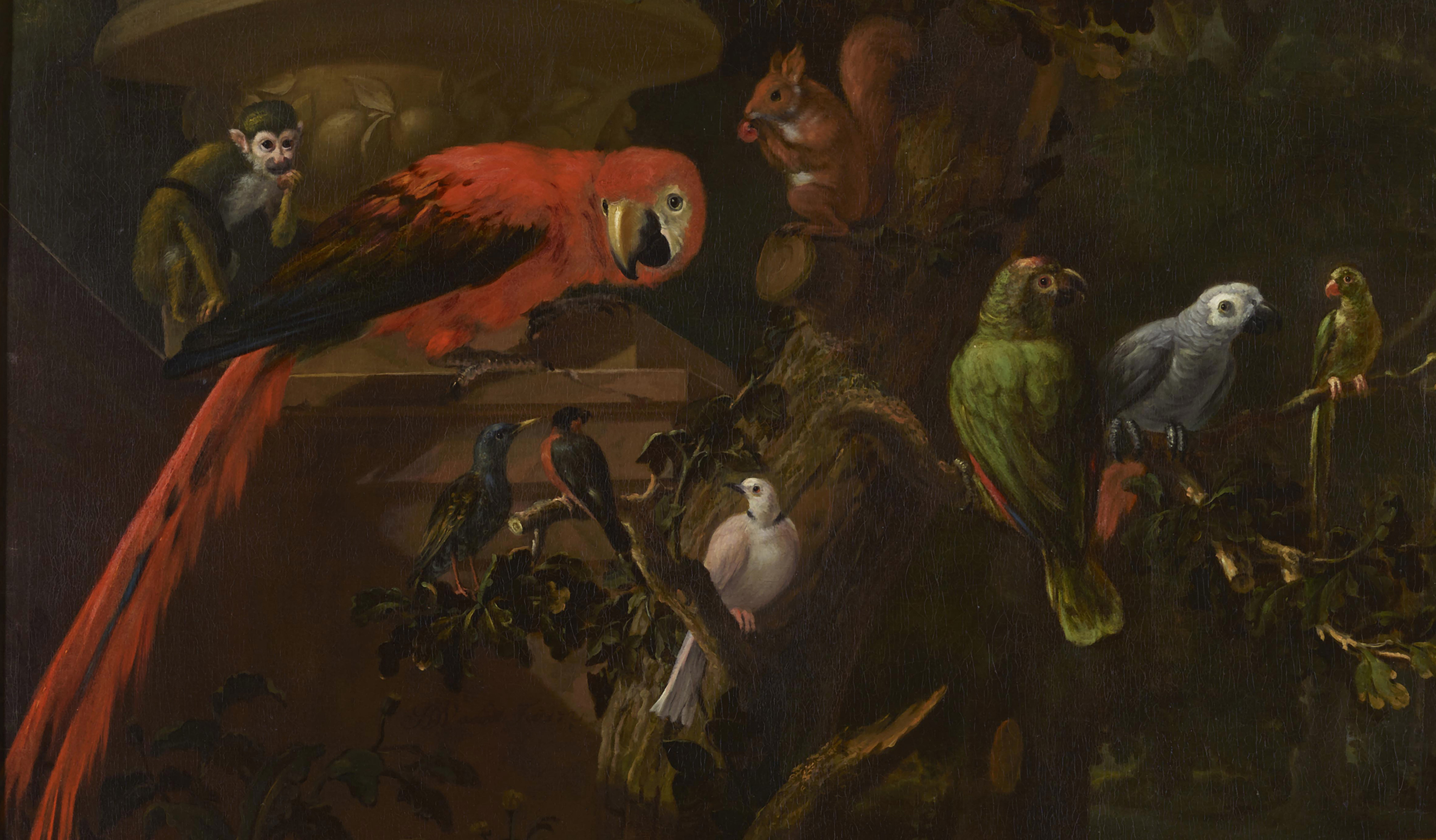
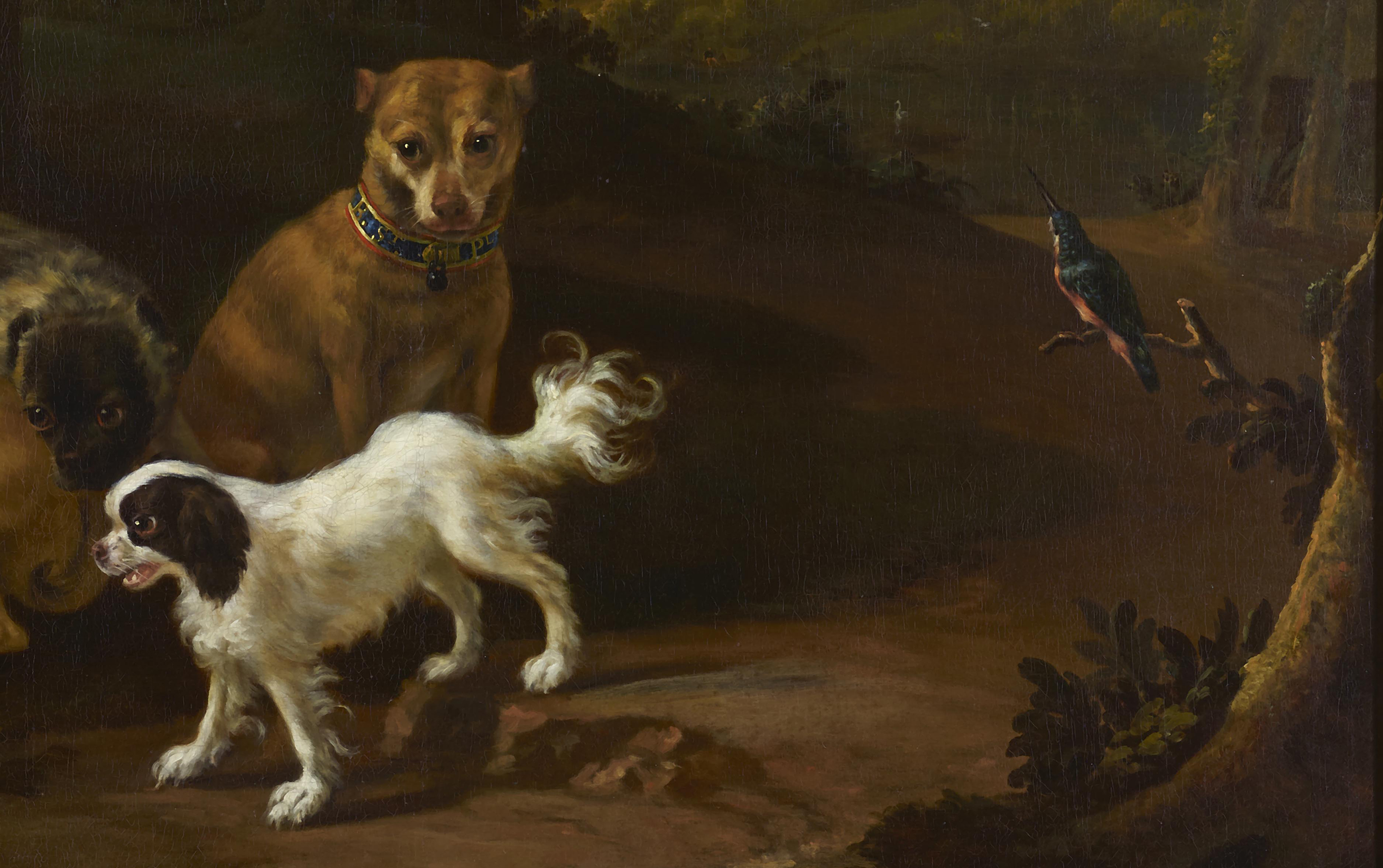
Dogs and a cat at the base of a tree with a red squirrel, squirrel monkey, parrots, macaw, parakeet, kingfisher, bull finch, starling and collared dove in the branches above
JAN VAN DER VAART
Dutch – English School
1647-1727
Pug dogs, a toy spaniel, a black old English terrier and a cat at the base of a tree with a red squirrel, squirrel monkey, yellow-crowned Amazon and African grey parrot, macaw, parakeet, kingfisher, bull finch, starling and collared dove in the branches above
Oil on canvas, signed and dated 1721
173 x 141
681/8 x 55½ inches
Overall framed size 194 x 166 cms
763/8 x 653/8 inches
Jan van der Vaart (also sometimes written as van der Waart, van der Vaardt or John Vandervaart) was born and baptised in Haarlem on 26th October 1689. As an artist, he was not restricted to any particular subject matter during his career and was adept at portraying still-life, history and religious subjects, portraits, small landscapes with figures and trompe l’oeil although he is probably best known for his landscapes and portraits. In later years he also produced mezzotints. As well as producing his own work, de Vaart was also a restorer, collector and art dealer.
He received instruction in painting in Haarlem from Thomas Wyck (or Wijck c.1616-1677), a landscape and genre painter who worked in the Italian manner. Van der Vaart worked for a while in Haarlem and there is a painting by him in a17th century Amsterdam inventory which is recorded as a barn interior, which is probably a work done in the popular Haarlem manner of Adriaen van Ostade 1610-1685. However, possibly following a recommendation from his teacher Thomas Wyck, who had gone to London in the reign of Charles II, van der Vaart travelled to England in 1673/4 where he remained for the rest of his life, becoming naturalised in 1708.
Between 1685 and 1687, van der Vaart was employed in the London studio of the Amsterdam-born portrait painter Willam Wissing (1653-1687). Wissing had been an assistant to the court painter Sir Peter Lely and van der Vaart was mainly responsible for representing the drapery and the landscape backgrounds in his employer’s pictures. Following Wissing’s death, van der Vaart remained in the former’s studio and established himself principally as a portraitist in his own right but occasionally in collaboration with the German-born painter Johann Kerseboom (?-1708) and there are fifty-two portraits attributed to van der Vaart.
Jan van der Vaart was one of the earliest practitioners of mezzotint engravings and he, together with Bernard Lens, produced engravings of his portraits and history scenes for the publisher Edward Cooper. He had a pupil John Smith (1652-1742) who later became a renowned mezzotint engraver.
There are anecdotes that van der Vaart’s eyesight had become a problem and that by 1713 he had given up his painting and print making business turning instead to restoration and art dealing. However, this does not chime with the recorded date of this painting and some other works as, for example, A classical landscape in the Leeds Museum which is dated to after 1715 and Two spaniels and a jay, which is somewhat redolent of a Jacob Bogdany and is dated 1714 and now in the National Trust’s Antony collection. It is also believed that he had sold his collection of paintings and built a house in Covent Garden. It seems that he had lived in that area for some time as in the 1693- 4 “4 shillings in the pound aid tax” he is recorded as residing in Bedford House, Covent Garden which was on the southern side of Henrietta Street. His nephew Arnold did however eventually take over the business at some point.
An interest in trompe l’oeil paintings had spread across Europe and it took various forms from imitating stone or bronze relief, optical architectural illusions, prosaic items hanging on walls or prints behind a broken pane of glass. Another format was that of the painting made to look like real wood, sometimes with a window opening from it or an object attached to the ‘panel’. A well-known practitioner of this technique was the Flemish painter Cornelis Norbertus Gijsbrechts (1610-c.1675) whose remarkable skill created illusions of glass-fronted cupboards with items on shelves inside. A consequence of this appetite for optical trickery evolved into integrating trompe l’oeil directly onto furniture. In the collection of the Duke of Devonshire’s Chatsworth there is a painted door with a violin and bow hanging from a hook to which is attached a blue ribbon. Horace Walpole, in his Anecdotes of painting in England, 1717-1797, writes that van der Vaart, who had worked for the Duke of Devonshire at Devonshire House in London, was responsible for this remarkable illusion of “…a violin against a door that deceived everybody” and which is so life-like as to be almost accepted as reality rather than a trick. It was originally incorporated into the wall in London but was removed to Chatsworth in the 18th century where it is now behind a real door off the music room. A trompe l’oeil painting measuring 81 x 40.3 cms by van der Vaart, almost identical to the Devonshire House painted door, came up for sale in Sotheby’s and made over £63,000. It is thought that the violins portrayed in both works were made by Hendrik Jacobsz. (1629-1699).
Jan van der Vaart died in London on 30th March 1721 and was buried at St Paul’s Church, Covent Garden.
Examples of his work are held in the following museums and institutions: National Portrait Gallery; Ashmolean; Fitzwilliam; Guildhall Art Gallery; Parliamentary Art Collection; Leeds Museum; National Trust (Lacock Abbey, Kedleston Hall, Chirk Castle, Antony, Chastleton House, Wimpole Hall); National Gallery of Scotland; Museum of Fine Arts, Ghent; Yale Center for British Art.
Some titles include: Two Spaniels and a Jay in a landscape; Hunting scene with Gilbert Coventry, later 4th Earl of Coventry (this is a large painting measuring 1.42 x 2.34 metres and was painted in conjunction with Jan Wyck); A floral still-life with a boy feeding cherries to two parrots (painted with Jacob Bogdany); Bifron’s Park, Kent (a large – 156.2 x 232.4 metres -impressive topographical landscape with riders in the foreground and a distant view of the estate and house in the distance; Thomas Osborne, 1st Duke of Leeds; Queen Anne; William IV; Mary II, Frances Teresa Stuart and Duchess of Richmond and Lennox.
We are grateful to Fred Meijer for confirming the attribution to Jan van der Vaart.
Bibliography:
A Dictionary of Dutch and Flemish Still-Life Painters, Working in Oils, 1525-1725 – Adriaan van der Willigen and Fred G Meijer
The Dictionary of British Eighteenth Century Painters – Ellis G Waterhouse
Trompe-l’oeil painting; The illusions of reality – Miriam Milman
Anecdotes of Painting in England, 1717-1797 – Horace Walpole
Dictionnaire des Peintres – E Benezit
Painting in Britain 1530-1790 – Ellis Waterhouse
National Portrait Gallery
RKD database
RELATED ITEMS






 was born and baptised in Haarlem on 26th October 1689. As an artist, he was not restricted to any particular subject matter during his career and was adept at portraying still-life, history and religious subjects, portraits, small landscapes with figures and trompe l’oeil although he is probably best known for his landscapes and portraits. In later years he also produced mezzotints. As well as producing his own work, de Vaart was also a restorer, collector and art dealer. He received instruction in painting in Haarlem from Thomas Wyck (or Wijck c.1616-1677), a landscape and genre painter who worked in the Italian manner. Van der Vaart worked for a while in Haarlem and there is a painting by him in a17th century Amsterdam inventory which is recorded as a barn interior, which is probably a work done in the popular Haarlem manner of Adriaen van Ostade 1610-1685. However, possibly following a recommendation from his teacher Thomas Wyck, who had gone to London in the reign of Charles II, van der Vaart travelled to England in 1673/4 where he remained for the rest of his life, becoming naturalised in 1708.Between 1685 and 1687, van der Vaart was employed in the London studio of the Amsterdam-born portrait painter Willam Wissing (1653-1687). Wissing had been an assistant to the court painter Sir Peter Lely and van der Vaart was mainly responsible for representing the drapery and the landscape backgrounds in his employer’s pictures. Following Wissing’s death, van der Vaart remained in the former’s studio and established himself principally as a portraitist in his own right but occasionally in collaboration with the German-born painter Johann Kerseboom (?-1708) and there are fifty-two portraits attributed to van der Vaart.Jan van der Vaart was one of the earliest practitioners of mezzotint engravings and he, together with Bernard Lens, produced engravings of his portraits and history scenes for the publisher Edward Cooper. He had a pupil John Smith (1652-1742) who later became a renowned mezzotint engraver. There are anecdotes that van der Vaart’s eyesight had become a problem and that by 1713 he had given up his painting and print making business turning instead to restoration and art dealing. However, this does not chime with the recorded date of this painting and some other works as, for example, A classical landscape in the Leeds Museum which is dated to after 1715 and Two spaniels and a jay, which is somewhat redolent of a Jacob Bogdany and is dated 1714 and now in the National Trust’s Antony collection. It is also believed that he had sold his collection of paintings and built a house in Covent Garden. It seems that he had lived in that area for some time as in the 1693- 4 “4 shillings in the pound aid tax” he is recorded as residing in Bedford House, Covent Garden which was on the southern side of Henrietta Street. His nephew Arnold did however eventually take over the business at some point.An interest in trompe l’oeil paintings had spread across Europe and it took various forms from imitating stone or bronze relief, optical architectural illusions, prosaic items hanging on walls or prints behind a broken pane of glass. Another format was that of the painting made to look like real wood, sometimes with a window opening from it or an object attached to the ‘panel’. A well-known practitioner of this technique was the Flemish painter Cornelis Norbertus Gijsbrechts (1610-c.1675) whose remarkable skill created illusions of glass-fronted cupboards with items on shelves inside. A consequence of this appetite for optical trickery evolved into integrating trompe l’oeil directly onto furniture. In the collection of the Duke of Devonshire’s Chatsworth there is a painted door with a violin and bow hanging from a hook to which is attached a blue ribbon. Horace Walpole, in his Anecdotes of painting in England, 1717-1797, writes that van der Vaart, who had worked for the Duke of Devonshire at Devonshire House in London, was responsible for this remarkable illusion of “…a violin against a door that deceived everybody” and which is so life-like as to be almost accepted as reality rather than a trick. It was originally incorporated into the wall in London but was removed to Chatsworth in the 18th century where it is now behind a real door off the music room. A trompe l’oeil painting measuring 81 x 40.3 cms by van der Vaart, almost identical to the Devonshire House painted door, came up for sale in Sotheby’s and made over £63,000. It is thought that the violins portrayed in both works were made by Hendrik Jacobsz. (1629-1699).Jan van der Vaart died in London on 30th March 1721 and was buried at St Paul’s Church, Covent Garden.Examples of his work are held in the following museums and institutions: National Portrait Gallery; Ashmolean; Fitzwilliam; Guildhall Art Gallery; Parliamentary Art Collection; Leeds Museum; National Trust (Lacock Abbey, Kedleston Hall, Chirk Castle, Antony, Chastleton House, Wimpole Hall); National Gallery of Scotland; Museum of Fine Arts, Ghent; Yale Center for British Art. Some titles include: Two Spaniels and a Jay in a landscape; Hunting scene with Gilbert Coventry, later 4th Earl of Coventry (this is a large painting measuring 1.42 x 2.34 metres and was painted in conjunction with Jan Wyck); A floral still-life with a boy feeding cherries to two parrots (painted with Jacob Bogdany); Bifron’s Park, Kent (a large – 156.2 x 232.4 metres -impressive topographical landscape with riders in the foreground and a distant view of the estate and house in the distance; Thomas Osborne, 1st Duke of Leeds; Queen Anne; William IV; Mary II, Frances Teresa Stuart and Duchess of Richmond and Lennox. We are grateful to Fred Meijer for confirming the attribution to Jan van der Vaart. Bibliography:A Dictionary of Dutch and Flemish Still-Life Painters, Working in Oils, 1525-1725 – Adriaan van der Willigen and Fred G MeijerThe Dictionary of British Eighteenth Century Painters – Ellis G WaterhouseTrompe-l’oeil painting; The illusions of reality – Miriam MilmanAnecdotes of Painting in England, 1717-1797 – Horace WalpoleDictionnaire des Peintres – E BenezitPainting in Britain 1530-1790 – Ellis WaterhouseNational Portrait GalleryRKD database)