
The chase
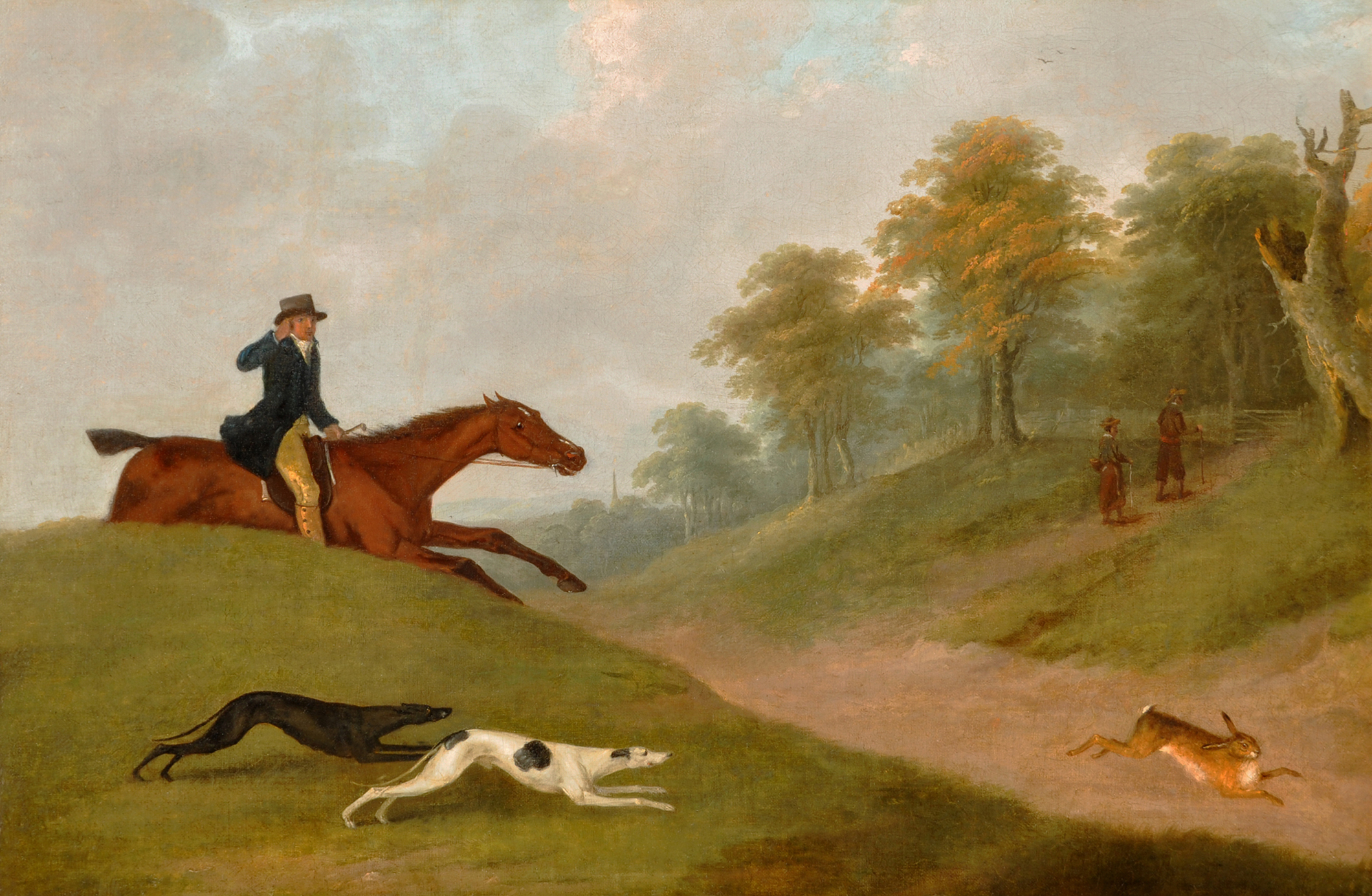
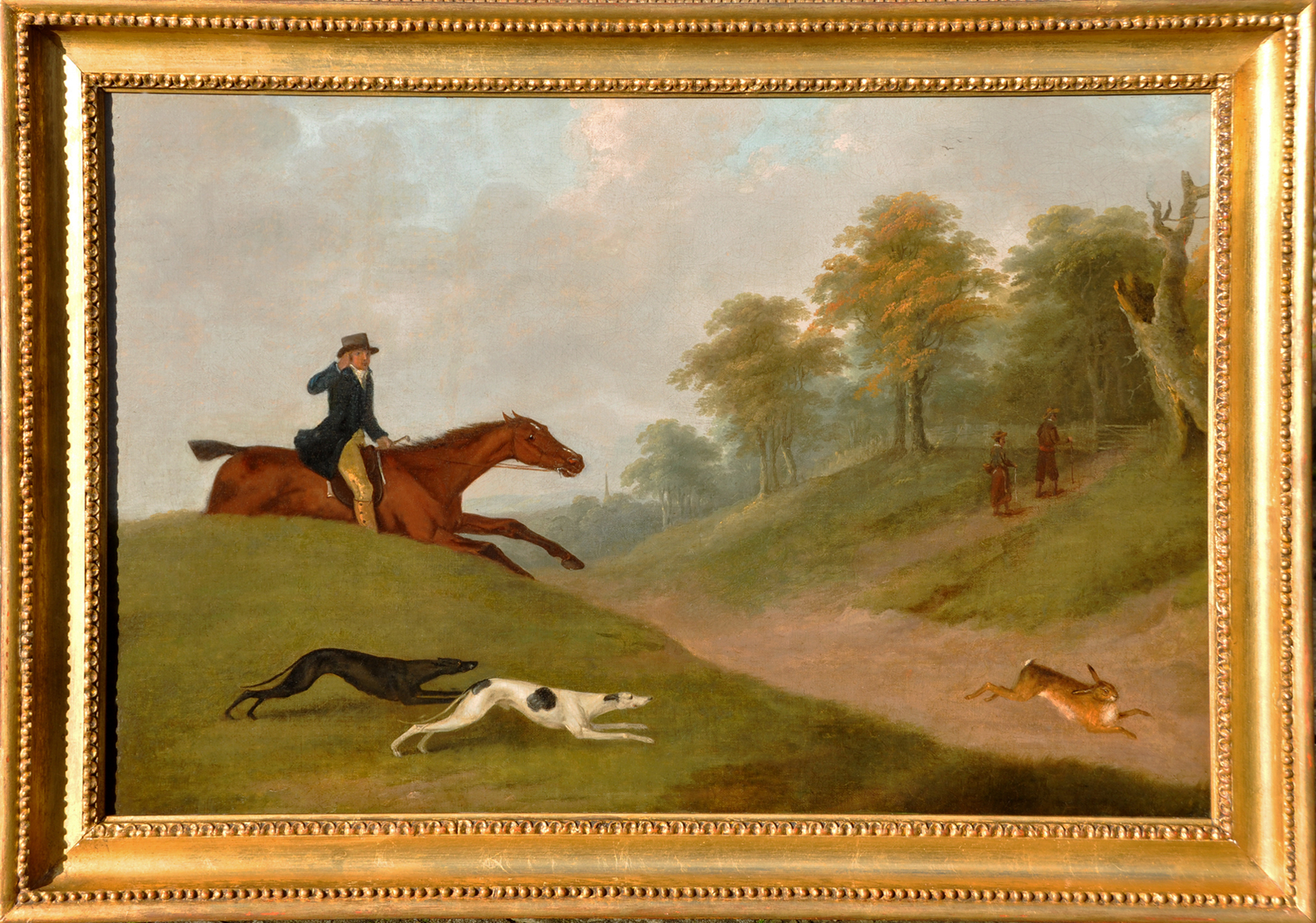
The chase
JOHN NOST SARTORIUS
English School
1759–1828
The chase
Oil on canvas
44 x 67.7 cms
171/4 x 265/8 inches
Overall framed size 54.6 x 77.3 cms
211/2 x 303/8 ins
John Nost (sometimes written as Nott) was the most prolific and best-known member of the large and talented Sartorius family of painters. He was the son of Francis Sartorius (1734-1804) and the grandson of John Sartorius (1700-c.1780). In order to be distinguished from his elders, he referred to himself in painting catalogues as ‘J. N. Sartorius junior.’ John Nott’s brother was the marine painter, Francis.
The family was of German descent and originally came from Nuremburg and John Nost’s grandfather arrived in England from Bavaria in the early eighteenth century. He was born in Westminster, London, in 1759 and John Nost, like the rest of his family, remained in London during his career.
John Nost concentrated most of his work on horses, both hunting and racing, but the occasional shooting scene and dog or cattle portraits are recorded and he exhibited a number of fruit still-lifes as well. The horse paintings range from portraiture to hunting and racing scenes. His style is more advanced than that of his father or grandfather yet he still retains an old-fashioned quality, even bordering on the naive at times. However, his depiction of his subjects is less naïve than that of the rest of his family and the horses tend to be rounder and softer. He was also superior to the rest of his family in his ability to paint the landscapes in which his subject matter is set and M H Grant in A Dictionary of British Landscape Painters says that “…in some early works this rises almost to the mastery of that of George Stubbs”. His compositions, especially among his hunting paintings, are excellent and quite engaging.
The Sartorius family were London-based and this centrality, aided by their apparent keen marketing ability, put them in an ideal position to win contracts to paint the animals of the wealthy resulting in all of them being successful. Their output was considerable which is interesting when one considers that by the time John Nott was in the later stages of his career, his style was already beginning to look a rather out of step with evolving tastes, belonging more to the eighteenth century rather than the more naturalistic style which was becoming fashionable. This continual winning of commissions in the face of changing tastes must indicate his connections to the right people and a good sense of business acumen.
John Nost exhibited seventy-eight works at the Royal Academy between 1781 and 1824, thirty-one at the Free Society between 1778 and 1783 and one at the Society of Artists in 1778. During these periods, these paintings were sent to the exhibitions from addresses in or near to Oxford St, St Martin’s Lane, Soho and Covent Garden even though he worked regularly at Newmarket (often for the Earl of Derby), Epsom for Lord Foley as well as staying on the estates of the aforementioned at Knowsley in Lancashire and Herefordshire respectively. Among other influential clients were the Prince of Wales, Charles James Fox - the Whig politician and statesman – the Duke of Cleveland at Raby Castle in Co. Durham as well as members of the Belvoir and Quorn Hunts. Despite this, he is reported to have spent a lot of time at an inn in Carshalton, Surrey.
Some titles of his paintings include: A huntsman taking a fence; The Earl of Darlington fox-hunting with the Raby pack, drawing cover; A hunting scene, finding the scent; A huntsman and fox hounds entering a wood; Landscape, in which is represented a new invented carriage; Portrait of a gentleman shooting; Portrait of a cow belonging to a gentleman in Essex; A Longhorn-Staffordshire cross; Portraits of spaniels flushing a woodcock; An old English terrier; Portrait of a remarkable three-year-old deer, the property of the Earl of Derby; Lord Foley’s Comrade beating Mr Goodison’s Foxbury and Mr Butler’s Epsom, for the plate over Epsom 1808; Unkennelling the hounds; A famous horse called Trentham and The Gold Cup, Epsom, May 1811.
There are forty-two engraved paintings, mainly portraits of racehorses and sixteen of his works were also published in The Sporting Magazine. J N Sartorius’s painting of Flying Childers and King Herod showing the two race horses held by gentlemen facing each other was etched and engraved by John Scott for John Lawrence’s History and the delineation of the Horse published in 1809.
His sons, John Francis, (c.1775-1831) was yet another sporting painter from this family but although he was a prolific exhibitor at the Royal Academy between 1797 and 1829, he painted fewer horse paintings compared to his forebears and more shooting scenes, game birds, dog and cow portraits and dead game still-lifes. Two other sons concentrated on marine painting: Francis (1782-after 1808) and Charles James (1790-after 1821). There was also a Miss M Sartorius who exhibited one still-life painting, A brace of Ruffs at the British Institution 1813 and sent from a Covent Garden address
Museums, Art Galleries and collections that hold examples of his paintings include: Tate Britain; The Museum of London (The dress chariot of the Sheriff of the City of London in the courtyard of the Guildhall, London 1807); Royal Collections Trust; Walker Art Gallery; Government Art Collection; National Horseracing Museum; The Fred Packard Museum and Galleries of British Sporting Art; Museum of English Rural Life; Royal Agricultural University Collection; Laing Art Gallery; Sheffield Museum; National Trust – Waddesdon Manor, Saltram, Fenton House, Upton House, Antony, Calke Abbey, Anglesey Abbey; National Trust for Scotland – Brodrick Castle; Yale Center for British Art; Art Institute of Chicago; Huntington Library (A match at Newmarket with the Prince of Wales’s Traveller beating Lord Grosvenor’s Meteor over the Beacon Course at Newmarket May 3rd 1790 and A match at Newmarket, The Duke of Bedford’s “Grey Diomed” beating the Prince of Wales’s “Traveller” over the Beacon Course at Newmarket May 8th 1790); Fine Art Museum of San Francisco.
One of J N Sartorius’s main legacies is the paintings depicting the finish at race meetings such as at Ascot, Newmarket and Epsom because their accuracy and attention to detail are important to any racing historian.
Bibliography:
The Dictionary of British Equestrian Artists - Sally Mitchell
A Dictionary of British Landscape Painters – M H Grant
The Dictionary of 18th Century British Painters – Ellis Waterhouse
British Sporting Artists - W Shaw Sparrow
Sporting Art in Britain exhibition catalogue 2003
RELATED ITEMS




 was the most prolific and best-known member of the large and talented Sartorius family of painters. He was the son of Francis Sartorius (1734-1804) and the grandson of John Sartorius (1700-c.1780). In order to be distinguished from his elders, he referred to himself in painting catalogues as ‘J. N. Sartorius junior.’ John Nott’s brother was the marine painter, Francis.The family was of German descent and originally came from Nuremburg and John Nost’s grandfather arrived in England from Bavaria in the early eighteenth century. He was born in Westminster, London, in 1759 and John Nost, like the rest of his family, remained in London during his career.John Nost concentrated most of his work on horses, both hunting and racing, but the occasional shooting scene and dog or cattle portraits are recorded and he exhibited a number of fruit still-lifes as well. The horse paintings range from portraiture to hunting and racing scenes. His style is more advanced than that of his father or grandfather yet he still retains an old-fashioned quality, even bordering on the naive at times. However, his depiction of his subjects is less naïve than that of the rest of his family and the horses tend to be rounder and softer. He was also superior to the rest of his family in his ability to paint the landscapes in which his subject matter is set and M H Grant in A Dictionary of British Landscape Painters says that “…in some early works this rises almost to the mastery of that of George Stubbs”. His compositions, especially among his hunting paintings, are excellent and quite engaging.The Sartorius family were London-based and this centrality, aided by their apparent keen marketing ability, put them in an ideal position to win contracts to paint the animals of the wealthy resulting in all of them being successful. Their output was considerable which is interesting when one considers that by the time John Nott was in the later stages of his career, his style was already beginning to look a rather out of step with evolving tastes, belonging more to the eighteenth century rather than the more naturalistic style which was becoming fashionable. This continual winning of commissions in the face of changing tastes must indicate his connections to the right people and a good sense of business acumen.John Nost exhibited seventy-eight works at the Royal Academy between 1781 and 1824, thirty-one at the Free Society between 1778 and 1783 and one at the Society of Artists in 1778. During these periods, these paintings were sent to the exhibitions from addresses in or near to Oxford St, St Martin’s Lane, Soho and Covent Garden even though he worked regularly at Newmarket (often for the Earl of Derby), Epsom for Lord Foley as well as staying on the estates of the aforementioned at Knowsley in Lancashire and Herefordshire respectively. Among other influential clients were the Prince of Wales, Charles James Fox - the Whig politician and statesman – the Duke of Cleveland at Raby Castle in Co. Durham as well as members of the Belvoir and Quorn Hunts. Despite this, he is reported to have spent a lot of time at an inn in Carshalton, Surrey.Some titles of his paintings include: A huntsman taking a fence; The Earl of Darlington fox-hunting with the Raby pack, drawing cover; A hunting scene, finding the scent; A huntsman and fox hounds entering a wood; Landscape, in which is represented a new invented carriage; Portrait of a gentleman shooting; Portrait of a cow belonging to a gentleman in Essex; A Longhorn-Staffordshire cross; Portraits of spaniels flushing a woodcock; An old English terrier; Portrait of a remarkable three-year-old deer, the property of the Earl of Derby; Lord Foley’s Comrade beating Mr Goodison’s Foxbury and Mr Butler’s Epsom, for the plate over Epsom 1808; Unkennelling the hounds; A famous horse called Trentham and The Gold Cup, Epsom, May 1811.There are forty-two engraved paintings, mainly portraits of racehorses and sixteen of his works were also published in The Sporting Magazine. J N Sartorius’s painting of Flying Childers and King Herod showing the two race horses held by gentlemen facing each other was etched and engraved by John Scott for John Lawrence’s History and the delineation of the Horse published in 1809.His sons, John Francis, (c.1775-1831) was yet another sporting painter from this family but although he was a prolific exhibitor at the Royal Academy between 1797 and 1829, he painted fewer horse paintings compared to his forebears and more shooting scenes, game birds, dog and cow portraits and dead game still-lifes. Two other sons concentrated on marine painting: Francis (1782-after 1808) and Charles James (1790-after 1821). There was also a Miss M Sartorius who exhibited one still-life painting, A brace of Ruffs at the British Institution 1813 and sent from a Covent Garden addressMuseums, Art Galleries and collections that hold examples of his paintings include: Tate Britain; The Museum of London (The dress chariot of the Sheriff of the City of London in the courtyard of the Guildhall, London 1807); Royal Collections Trust; Walker Art Gallery; Government Art Collection; National Horseracing Museum; The Fred Packard Museum and Galleries of British Sporting Art; Museum of English Rural Life; Royal Agricultural University Collection; Laing Art Gallery; Sheffield Museum; National Trust – Waddesdon Manor, Saltram, Fenton House, Upton House, Antony, Calke Abbey, Anglesey Abbey; National Trust for Scotland – Brodrick Castle; Yale Center for British Art; Art Institute of Chicago; Huntington Library (A match at Newmarket with the Prince of Wales’s Traveller beating Lord Grosvenor’s Meteor over the Beacon Course at Newmarket May 3rd 1790 and A match at Newmarket, The Duke of Bedford’s “Grey Diomed” beating the Prince of Wales’s “Traveller” over the Beacon Course at Newmarket May 8th 1790); Fine Art Museum of San Francisco. One of J N Sartorius’s main legacies is the paintings depicting the finish at race meetings such as at Ascot, Newmarket and Epsom because their accuracy and attention to detail are important to any racing historian. Bibliography:The Dictionary of British Equestrian Artists - Sally MitchellA Dictionary of British Landscape Painters – M H GrantThe Dictionary of 18th Century British Painters – Ellis WaterhouseBritish Sporting Artists - W Shaw Sparrow Sporting Art in Britain exhibition catalogue 2003)